Your Most Popular Content Is More Insidious Than You Think
What we leave behind eventually becomes what we are remembered for.
The internet never forgets.
Not your tweets from 2013. Not your Facebook albums from college. Not that painfully enthusiastic lockdown reel featuring a trending audio that disappeared faster than your attention span.
We’ve spent years worrying about our digital footprints because we understand what they represent: reputation, identity, legacy.
Employers look at them. Universities screen for them. Brands audit them. Politicians lose elections because of them.
Because somewhere deep down, we know this:
What we leave behind eventually becomes what we are remembered for.
Which raises an uncomfortable question.
We’ve become increasingly conscious of our digital footprint.
Have we given the same thought to its climate footprint?
Because, unlike a poorly aged Instagram caption, the atmosphere doesn’t offer a delete button.
But emissions are only the beginning of the story.
Content leaves traces long after we stop scrolling past it. It shapes what we buy, where we travel, what we consider desirable, what we discard and, eventually, what we come to accept as normal.
So perhaps the climate footprint of content cannot be measured only in the electricity required to create and distribute it.
We also need to measure what that content sets in motion.
The footprints we don’t measure
A digital action feels weightless.
You upload a video.
Nothing physical happened.
Except it did.
Because every piece of content leaves more than one footprint: an infrastructure footprint, a behavioural one, and a cultural one.
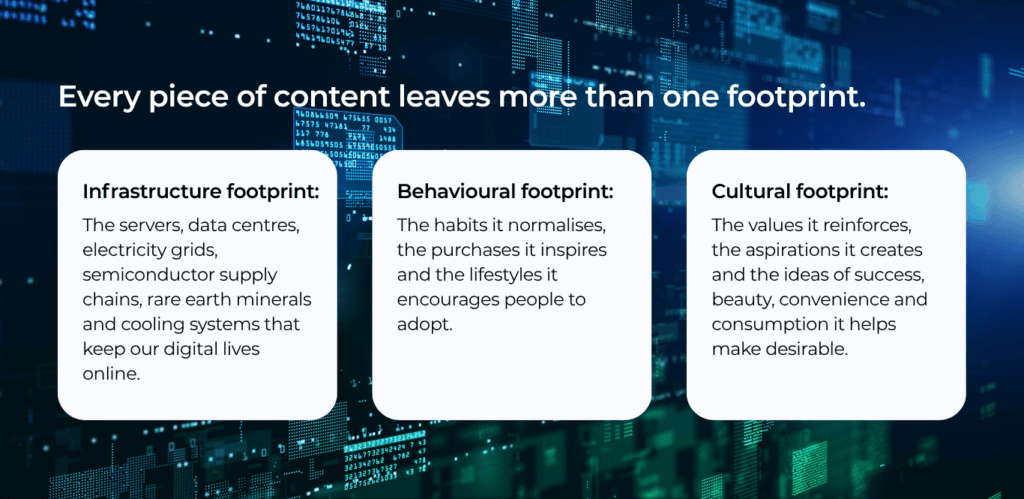
These footprints may begin on a screen, but they rarely stay there. And sometimes, the invisible footprints outlast the content itself.
The business of influence has never been bigger
The creator economy is no longer a niche corner of the internet. It has become one of the fastest-growing industries in the world.
According to Goldman Sachs, the global creator economy is already worth around USD 250 billion and is projected to approach USD 480 billion by 2027. Global spending on influencer marketing alone is expected to exceed USD 30 billion in 2025.
This matters because every campaign, every trend and every recommendation now has the potential to influence millions of purchasing decisions almost instantly.
The environmental question is therefore no longer limited to “How much electricity does the internet consume?“
It is “What happens when one recommendation changes the behaviour of ten million people?”

The age of infinite content and finite resources
Never before have so many people made a living from influencing what the rest of us buy, wear, eat, travel to or aspire towards.
Every minute, creators, brands and businesses collectively publish millions of pieces of content across platforms. In an economy where attention has become currency, producing more has quietly become synonymous with growing more.
Brands are posting four reels a day because somebody on LinkedIn announced that consistency beats creativity.
Marketing teams generate hundreds of AI visuals for campaigns that may survive exactly 48 hours before disappearing into archives nobody will ever revisit.
The platforms reward frequency. Brands reward visibility. Algorithms reward consistency. Agencies reward engagement. Somewhere along the way, creating content stopped being an act of communication and became an industrial process.
Influencers fly halfway around the world to create content about sustainable living.
Somewhere along the way:
- Volume became strategy.
- Consumption became engagement.
- Engagement became purpose.
- Virality became value.
And very few people stopped to ask why.
Why is “post every day” treated as unquestionable marketing advice?
Why do we measure impressions but rarely measure the overconsumption those impressions induce?
Why is campaign success defined by clicks, conversions and reach, while the behaviour created by those clicks and conversions remains outside the dashboard?
And why do we assume that creating “awareness” is automatically positive without asking what, exactly, we are making people aware of, desire or consume?
We built an industry remarkably good at measuring attention.
We are considerably less interested in measuring its consequences.
This isn’t simply a criticism of creators.
It is a reflection of the ecosystem we’ve collectively built. An ecosystem where visibility is monetised, and success is increasingly tied to producing more, publishing faster and staying constantly relevant.
Perhaps the greatest trick capitalism ever pulled was convincing us that creating more automatically means contributing more.
Often, it simply creates noise.
And occasionally, it creates demand for things nobody needed until an algorithm convinced them otherwise.
Content doesn’t just reflect culture. It manufactures it.
The internet rewards one currency above almost everything else: attention.
Not necessarily accuracy.
Not usefulness.
Not longevity.
Attention.
And attention is often easiest to capture by manufacturing desire.
The must-have.
The limited drop.
The upgrade.
The haul.
The destination everyone suddenly needs to visit before everyone else does.
The product you had never heard of yesterday but somehow cannot live without today.
Popularity, then, is not always neutral.
Because the most successful content isn’t necessarily the content people needed. Often, it is simply what persuaded the greatest number of people to want something.
And that distinction matters.
Because manufactured desire becomes manufactured demand.
Manufactured demand becomes manufactured product.
And every manufactured product eventually creates a physical burden that somebody, somewhere, has to carry.
Products don’t simply appear on shelves. They carry the environmental history of everything it took to get them there: extraction, manufacturing, transportation, packaging and eventual disposal. The algorithm moves on to the next trend. Landfills don’t.
The behavioural footprint begins when content moves from the screen into the real world.
A “must-have” skincare routine doesn’t end with a million views. It can create demand for ten products where two once sufficed. That demand travels backwards through the supply chain: more ingredients, more manufacturing, more packaging, more transport and, eventually, more waste.
A viral travel reel can send thousands of visitors towards a destination whose roads, water systems and waste infrastructure were never designed for them.
An outfit worn once for content can inspire thousands of purchases, triggering production, shipping and packaging for a trend that may disappear before the clothes reach the back of the wardrobe.
Even aesthetic minimalism, somehow, can end with thirty-seven newly purchased storage containers.
This is what a behavioural footprint looks like.
Content creates aspiration. Aspiration influences behaviour. Behaviour creates demand. And demand has a supply chain.
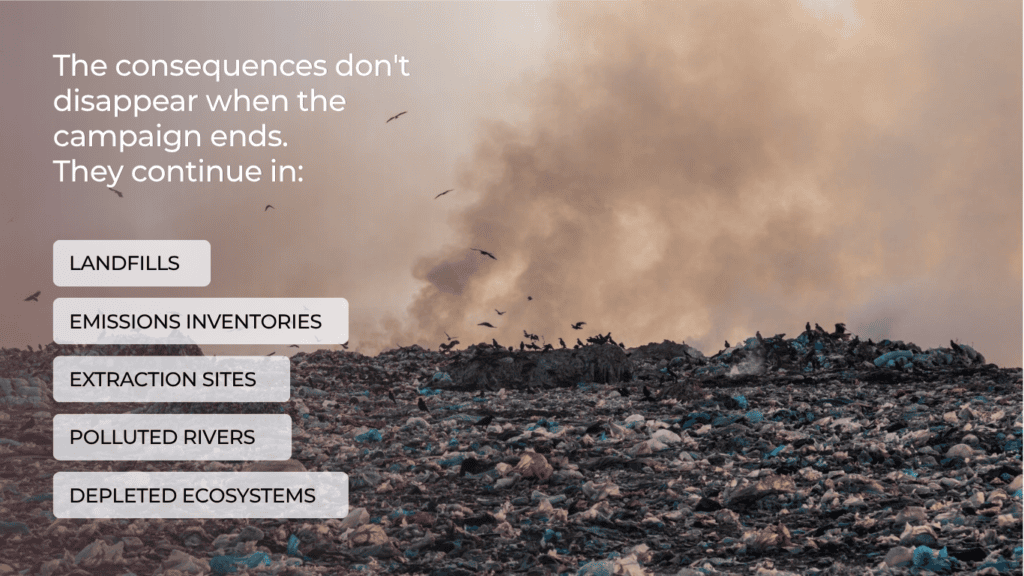
The consequences don’t disappear when the campaign ends.
The side-effects are no longer theoretical
Today, social media trends don’t simply reflect consumer behaviour.
They create it.
The environmental footprint doesn’t begin when someone checks out. It begins much earlier, the moment content succeeds in making unnecessary consumption feel necessary.
Increasingly, the most valuable asset in marketing isn’t shelf space.
It’s attention.
And attention, at scale, has become one of the world’s most powerful consumption engines.
Create for value, not virality
This isn’t an argument for or against the creator economy.
The creator economy has democratised storytelling, education, entrepreneurship and creativity in remarkable ways.
The question isn’t whether creators should exist.
It is whether the influence they build can also be measured by the value it leaves behind.
It is an argument for creating with greater intention because content can leave positive footprints too.
A tutorial that teaches someone to repair an appliance instead of replacing it.
A campaign that makes public transport more desirable.
A guide that helps households reduce food waste.
A documentary that shifts public opinion and influences conservation policy.
A creator who makes reusing, repairing or buying less feel aspirational.
These pieces of content leave footprints too.
Just very different ones.
The goal, then, isn’t simply to create less content.
It is to create content that leaves behind more value than waste.
Before hitting publish, ask one uncomfortable question:
If this content succeeds exactly as intended, what behaviour will it create in the real world?
Will it:
- Help people make better choices?
Or will it simply move another product through another supply chain towards another landfill?
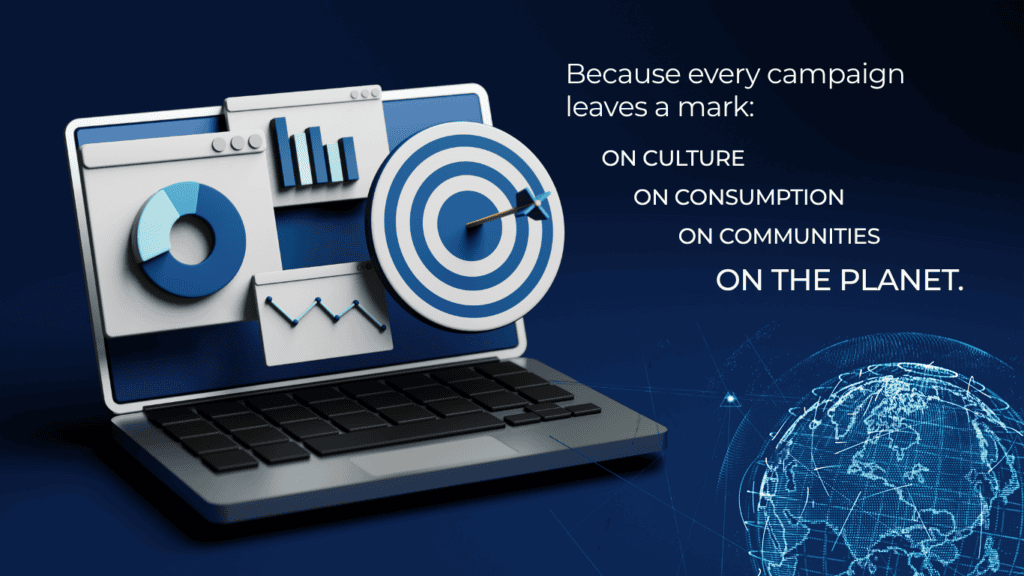
Because every campaign leaves a mark.
The legacy question
Someday our digital footprint will become an archival record.
Future generations will scroll through our timelines the way we read history books.
What will they find?
Evidence of creativity? Curiosity? Solutions? Community?
Perhaps the more important question isn’t whether our content went viral.
It is:
What did that virality set in motion?
Because the consequences of popularity don’t end when the views stop climbing.
It could also be evidence that unprecedented technological capability was spent chasing attention, feeding algorithms, manufacturing trends, and driving consumption simply to keep an infinite feed full.
Not every piece of popular content creates value.
Some simply consume energy, attention and creative resources in pursuit of a metric that will be forgotten by next week. Which brings us back to the question we perhaps should have been asking all along:
What did this content leave behind?
We’ve spent years teaching people to protect their digital footprints. Perhaps it is time we expanded our definition of what a footprint actually is.
Because the real measure of content may never have been how many people saw it.
It is what happened because they did.
One footprint determines how history remembers us.
The other is the world we leave behind to do the remembering.