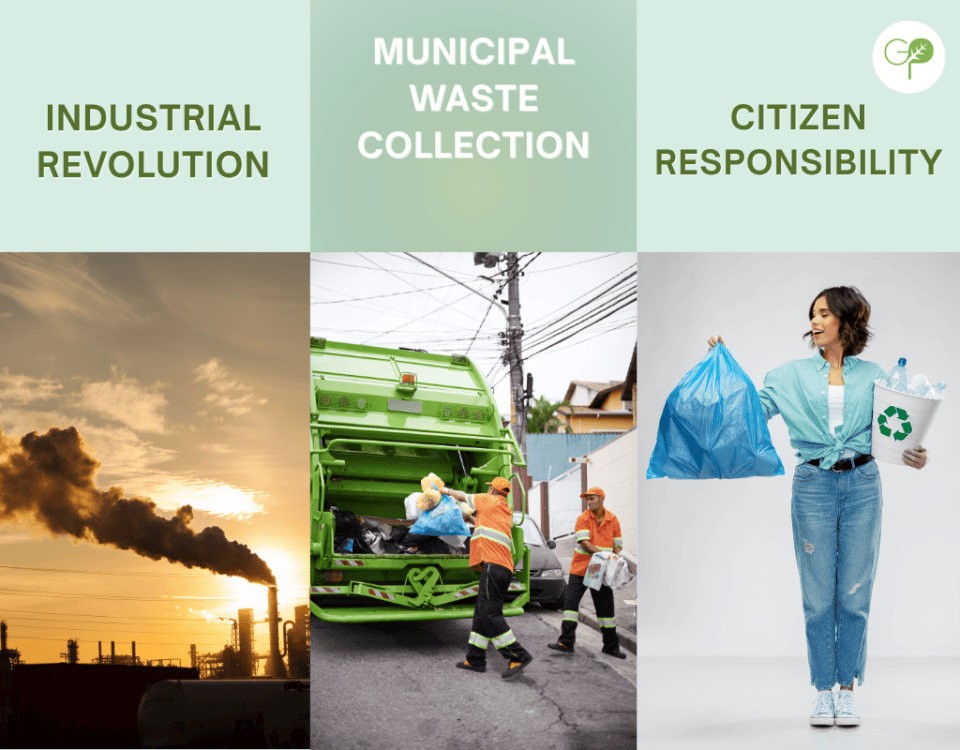
Waste Management: The Truth About Industrial Revolution & Citizen Responsibility
A clean city cannot be achieved solely by expanding municipal services. It requires citizens to recognise that waste is not merely something to be discarded, but a resource to be managed responsibly. The long-term solution is not simply to collect more waste—it is to create less of it, recover more of it, and ensure that every citizen shares responsibility for the environmental impact of their consumption.
The modern system of municipal solid waste management was born out of a specific historical crisis—the Industrial Revolution in Europe. The waste collection systems that many countries, including India, continue to follow today were developed to address the unique public health challenges of rapidly industrializing European cities over two centuries ago.
Today, however, India finds itself following a model inherited from the colonial era, despite having vastly different historical, cultural, and social conditions. As our cities continue to struggle with mounting waste generation, it is worth asking whether a system designed for nineteenth-century Europe remains the most suitable solution for twenty-first-century India.
The Industrial Revolution and the Birth of Municipal Waste Management
Before the Industrial Revolution, most Europeans lived in small rural communities where waste generation was minimal and largely biodegradable. Household waste was commonly reused, composted, fed to animals, or left to decompose naturally. In the late eighteenth century, industrialisation drew millions into rapidly expanding cities, and overcrowding outpaced urban planning. Infrastructure failed to keep pace with the unprecedented pace of urbanisation.
Without proper sanitation, human excreta, household refuse, animal waste, and industrial waste accumulated in streets and waterways, creating severe public health hazards and deadly outbreaks of diseases like Cholera, Typhoid fever, and dysentery, forcing governments to intervene.
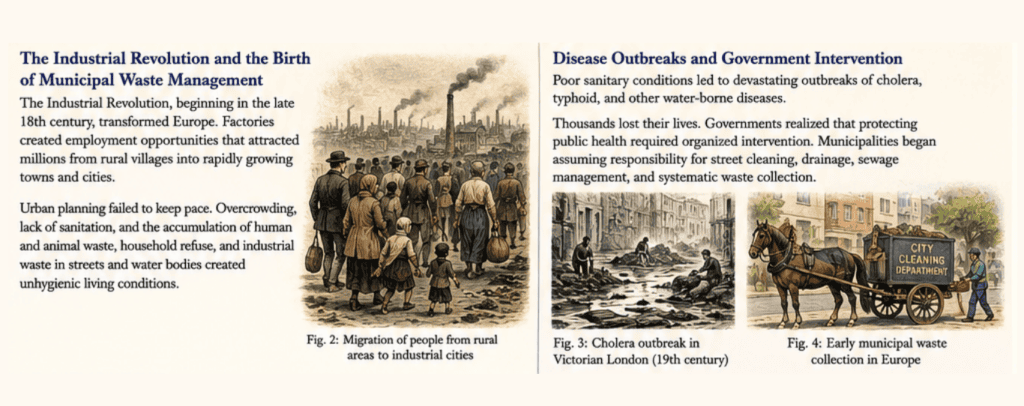
By 1849, about 53,000 cholera deaths were registered for England and Wales. During the 1854 cholera outbreak, nearly 600 people died within a week, exposing the devastating consequences of poor sanitation. In response, municipalities introduced organised systems for street cleaning, sewage management, and household waste collection to curb diseases and protect growing urban populations. What began as an emergency public health response gradually evolved into the municipal waste collection systems that remain the foundation of modern waste management today.
The Colonial Transfer of European Sanitation Systems
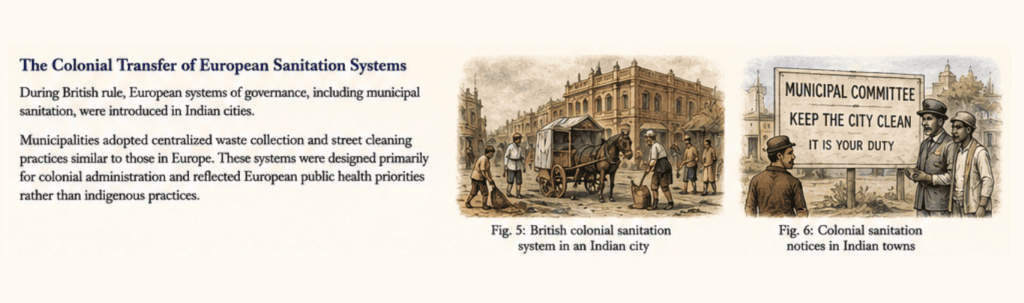
During British colonial rule, many administrative systems developed in Europe were introduced in India, including municipal sanitation and centralised waste collection. These systems were designed to address urban public health concerns in colonial cities rather than reflect India’s traditional resource-use practices. After Independence, India largely retained this framework, and municipal waste collection expanded alongside rapid urbanisation.
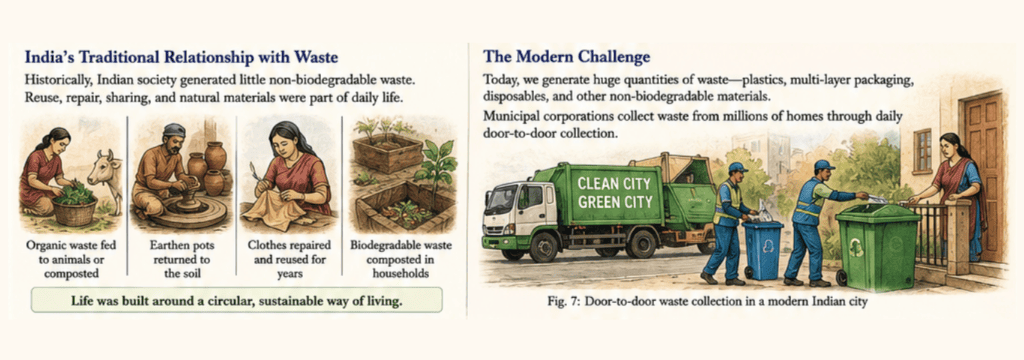
Historically, Indian society generated comparatively very little non-biodegradable waste. Everyday life was built around reuse, repair, sharing, and natural materials, reflecting principles of a circular economy.
- Earthen pots returned to the soil
- Cloth was repeatedly repaired until finally being repurposed as cleaning rags
- Metal utensils lasted generations
- Organic waste was fed to livestock or composted
- Packaging was minimal and largely biodegradable.
This does not imply that ancient India had no sanitation challenges. Historical evidence shows that cities required systems for drainage, cleaning, and public hygiene. However, the scale and composition of waste were fundamentally different from today’s predominantly plastic and synthetic waste streams.
The Modern Challenge
India today generates enormous quantities of municipal solid waste every day. Much of this waste consists of plastics, multilayer packaging, disposable products, and other materials that neither decompose naturally nor possess immediate economic value.
Municipal corporations are responsible for collecting waste directly from millions of households through daily door-to-door collection systems.
While this service has significantly improved cleanliness in many urban areas, it has also created an unintended consequence: many citizens increasingly perceive waste management as being entirely the government’s responsibility.
The act of placing waste outside one’s home is often considered the end of personal or public responsibility.
In reality, it is only the beginning of the waste management chain.
Is Door-to-Door Collection Still the Right Model?
Door-to-door waste collection is a highly resource-intensive public service requiring vehicles, fuel, manpower, infrastructure, transfer stations, and disposal facilities.
As cities continue to expand, maintaining this model becomes increasingly expensive and operationally challenging.
This raises an important philosophical question:
To what extent should governments be responsible for managing waste generated within individual households?
Governments undoubtedly have a duty to maintain clean public spaces, roads, parks, drains, and community infrastructure. However, expecting municipalities to remove waste from every doorstep every day places the entire burden of household waste management on municipal institutions.
By comparison, since governing bodies do not cook meals, wash dishes, clean private homes, or perform other routine household responsibilities, waste generated inside a home is also, fundamentally, a household responsibility.
This perspective suggests that the current system may unintentionally discourage citizens from taking ownership of the waste they create.
A New Model: Returning Responsibility to Citizens
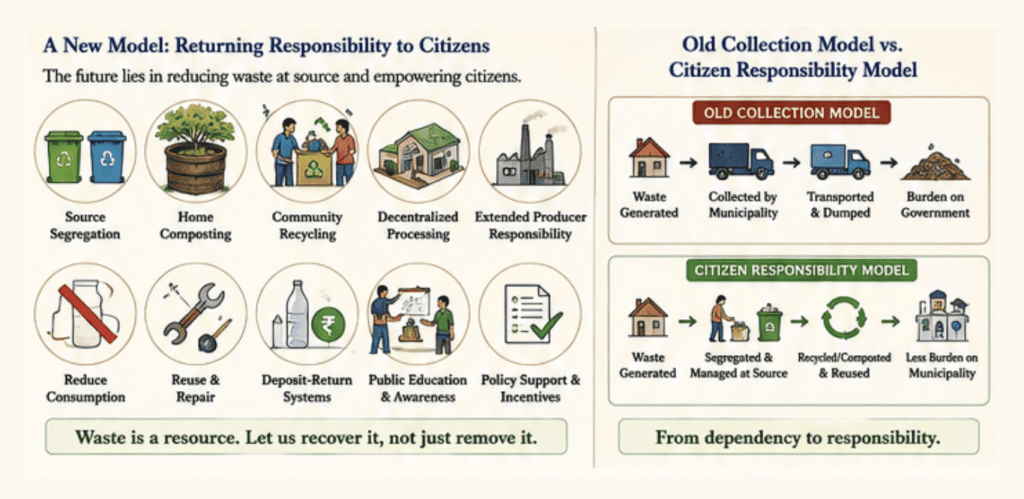
The future of sustainable waste management may lie in redistributing responsibility rather than continuously expanding municipal services.
Instead of treating waste collection as the primary solution, governments could focus on enabling citizens to manage their waste responsibly through:
- Source segregation.
- Home composting of biodegradable waste.
- Community-level recycling systems.
- Decentralised material recovery facilities.
- Extended Producer Responsibility for packaging manufacturers.
- Incentives for waste reduction and reuse.
- Deposit-return systems for recyclable materials.
- Public education focused on reducing waste generation rather than simply disposing of it.
Under this model, municipalities would still manage public sanitation and collect non-recyclable residual waste, while households would actively reduce and recover their own waste—a framework already in place, yet unevenly enforced and underutilised.
Let’s Build a Circular Waste System
The municipal waste collection systems operating across much of the world originated as public health responses to the overcrowded industrial cities of nineteenth-century Europe. Through colonial administration, these systems became embedded in India’s governance structures and have continued largely unchanged for decades.
However, today’s environmental challenges require more than efficient waste collection. They demand a transformation in public behaviour.
A clean city cannot be achieved solely by expanding municipal services. It requires citizens to recognize that waste is not merely something to be discarded, but a resource to be managed responsibly.
The long-term solution is not simply to collect more waste—it is to create less of it, recover more of it, and ensure that every citizen shares responsibility for the environmental impact of their consumption.
The future of solid waste management should therefore move beyond a government-led collection model toward a partnership in which governments provide enabling infrastructure and regulation, while citizens take primary responsibility for reducing, segregating, recycling, and recovering the waste they generate. Such a shift would not only reduce the burden on municipalities but also build a more sustainable, circular, and environmentally responsible society.
References:

Firdosh Roowalla is the founder of The Green Thumb, a circular waste management company dedicated to transforming everyday kitchen and organic waste into valuable resources. Through on-site waste management solutions for housing societies, his company converts wet waste into compost, biomass briquettes, and liquid organic fertilizer, helping communities manage waste at its source. His work is driven by the belief that circular waste management begins where waste is generated, making this his contribution to building a more sustainable, circular economy.