Why Malala Belongs in Every Conversation About the Future
Most of us know Malala for one defining moment. But beyond the headlines is someone with a wicked sense of humour, a refreshing approach to leadership, and an unwavering belief in the power of education. This Malala Day, we’re celebrating not just what she’s achieved, but why people like her matter.
Most of us know Malala Yousafzai for one defining moment. She’s the youngest Nobel Peace Prize laureate. The girl who survived the unimaginable. The activist who changed the conversation on girls’ education.
But that’s not why we’re celebrating her.
Or rather, that’s not the whole reason.
We’re a woman-led sustainability platform — and yes, that means we talk about the environment. But it also means we pay attention to the people, ideas, and leadership styles that make lasting change possible. And Malala Yousafzai is one of those people.
She’s Not Just Inspiring. She’s Interesting.
If your only reference for Malala is a stage and a microphone, you’re missing half the story.
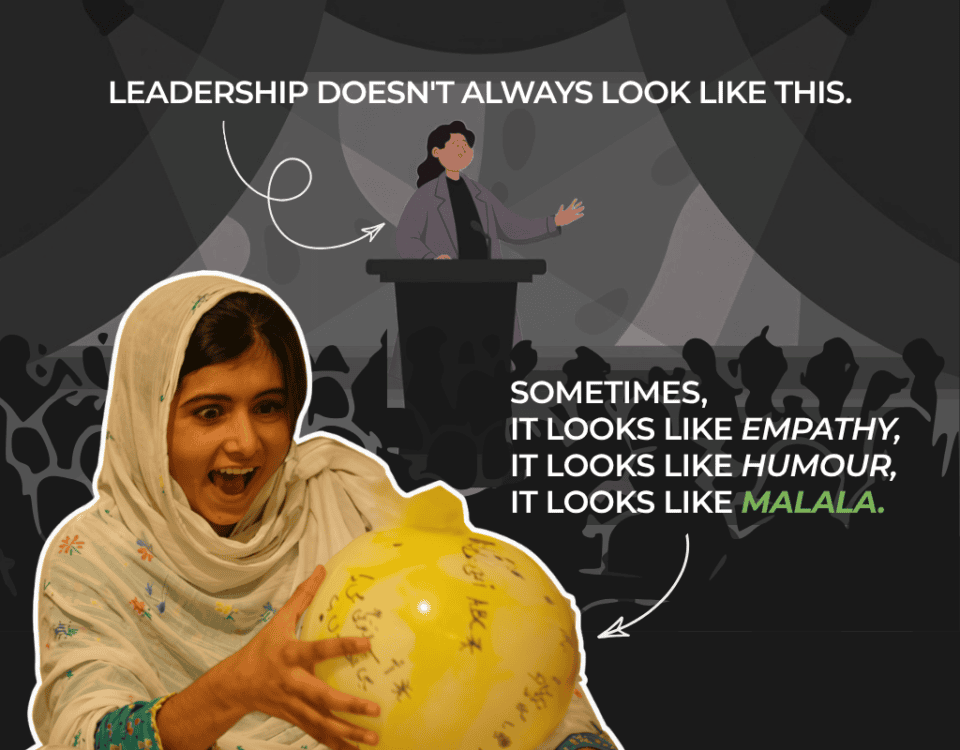
Follow her on social media, and you’ll find someone who posts about cricket with genuine enthusiasm, documents her travels with the energy of someone who is genuinely delighted to be in the world, and is — let’s be honest — very funny. She makes self-deprecating jokes. She celebrates small things. She doesn’t perform gravitas 24/7, and she doesn’t seem particularly interested in being treated like a monument.
And, perhaps most surprisingly, she’s only 29.
She graduated from Oxford. She co-founded a global organisation. She runs a production company, Extracurricular, that is actively bringing overlooked stories to screen, including her documentary on South Korea’s legendary women divers. She has written books for adults, books for children, and a memoir that has been read by millions.
None of this is trivia. It’s evidence that leadership doesn’t have to look solemn. That you can be doing serious, meaningful work in the world and still show up as a full human being.
Maybe that’s what makes her so compelling. She doesn’t ask people to admire her. She invites them to join her.
What She’s Building Will Outlast Her
What Malala has built through the Malala Fund isn’t a monument to herself — it’s a machine that creates opportunity. She works with local educators and activists already doing the work on the ground, advocates for government investment in education, and focuses on girls in conflict-affected regions where access to school isn’t a given.
Her storytelling follows the same logic. In We Are Displaced, she doesn’t centre herself — she shares the stories of refugee girls. Through Extracurricular, she creates space for voices that rarely get a global platform.
This is what quality education for all looks like in practice. Not a policy statement. Not a conference panel. The UN calls it Sustainable Development Goal 4 (SDG 4), but beyond the acronym lies something much simpler: a sustained, ground-level commitment to making sure every girl gets to learn, lead, and choose her own future.
And here’s what’s worth remembering: education isn’t just one of the UN’s Sustainable Development Goals. It’s the foundation on which so many others depend.
Honestly? We’re Fans.
The world doesn’t need more leaders with all the answers. It needs more leaders willing to listen, collaborate, and make room for others. That’s one of the reasons we’re drawn to people like Malala—not because they’re exceptional (though she clearly is), but because of how they lead.
They don’t need to be the loudest person in the room. Or the smartest, for that matter. They don’t confuse visibility with leadership, or influence with importance. They lead with empathy, consistency, curiosity, and yes, a sense of humour. They do the work without making themselves the story.
As a women-led team, we’d like to see more of that. Yes, because it sounds like a nice idea, but also because the planet genuinely needs leaders who are more interested in creating change than in being credited for it.
Malala is one of those leaders. And we think that deserves to be said out loud.
The Ripple Effect
Here’s the thing about women who lead the way Malala does: the impact doesn’t stay contained to one cause. Just like sustainability isn’t only about protecting ecosystems—it’s about building societies that can thrive for generations. And that isn’t possible without educated girls, equitable opportunities, and leaders willing to invest in others beyond themselves.
When girls stay in school, communities become more stable.
When women enter decision-making, policies become more equitable.
When more voices are included, more problems actually get solved.
Malala’s work creates the conditions for gender equality, economic opportunity, and a more resilient world—even when it doesn’t announce itself that way.
When women take a stand, it changes things. Sometimes in big, visible ways. Sometimes quietly. But it changes things.
Now, It’s Your Move
Malala’s story reminds us that change rarely begins with institutions. It begins with people who decide to speak, act, and persist—even when the odds are against them.
Celebrating Malala is easy. The harder, and probably more important, thing is asking what it means to actually support people like her. If we want more people like Malala, we can’t just celebrate them after they’ve changed the world. We have to believe in them while they’re still trying.
It means listening to women who are already doing the work. Investing in them. Amplifying them. Not waiting for them to become Nobel laureates before we pay attention.
So today, don’t just celebrate Malala.
Think of someone in your life whose voice deserves to be heard — but who hasn’t quite found the confidence to use it yet. Share this with them. Tell them you believe in them.
The next person to create meaningful change might just need someone to say: I see you. Go.