
Rain to Resource: DIY Projects You Can Try This Monsoon
The monsoon does the same thing every year. Maybe this time, you can experience it a little differently.
There’s something about the monsoon that slows everything down. The air is heavier, balconies glisten with rain, and the outdoors becomes something you watch rather than step into. But along with the calm, the season also brings its share of small disruptions—damp corners, overwatered plants, laundry that refuses to dry, and water that simply slips away unused.
In cities like Mumbai, where a single downpour can flood streets within hours, or in Bangalore, where balconies turn into miniature rain zones, the monsoon isn’t subtle—it’s immersive.
What if, instead of working around it, we worked with it?
The rainy season is an invitation—to rethink how we use water, how we care for our homes, and how small, intentional shifts can make everyday living more sustainable. It doesn’t require large changes. A few thoughtful DIY projects can turn the monsoon into a season of resourcefulness rather than inconvenience.

1. A DIY Rain Chain (Monsoon ASMR)
[Effort: Medium | Impact: Medium | Cost: Medium]
- The Why:
A rain chain swaps your plain old downspout for something far more satisfying—turning rain into a gentle cascade while directing it into a barrel or garden where it can actually be useful. It does the same job—but turns it into something you can see, manage, and even enjoy. - The What:
- An existing gutter outlet (or a 2–2.25-inch opening)
- A weather-resistant chain or linked metal cups
- A simple hook or adapter to secure it
- A collection point at the base—like a pot, gravel basin, or storage drum
- The How:
- Remove your existing downspout, or create an outlet where water naturally exits
- Secure a hook or adapter at the opening and attach the chain so it hangs straight
- Guide the base into a pot, basin, or storage container
- Test with water—flow should follow the chain cleanly without splashing outward
- Style note: For a distinctly Indian/monsoon aesthetic, small terracotta pots or brass cups linked along the chain work well and are easy to source locally.
- Impact:
Unlike enclosed pipes, rain chains rarely clog, require minimal maintenance, and make rooftop runoff visible—encouraging you to collect or redirect it, rather than letting it disappear into a drain.
2. A Mini Percolation Pit (Doing Your Bit)
[Effort: Medium | Impact: High | Cost: Low]
- The Why:
Instead of storing rainwater, a percolation pit sends it back where it belongs—underground. It’s a simple way to help recharge groundwater, one rainy day at a time.- Note: This is best suited for independent homes, ground-floor units with a garden patch, or housing society common areas—not upper-floor balconies.
- The What:
- A small unpaved patch of land
- Basic digging tools
- Layered filling material—large stones, gravel, and coarse sand
- A simple mesh cover
- A top slab or grate
- The How:
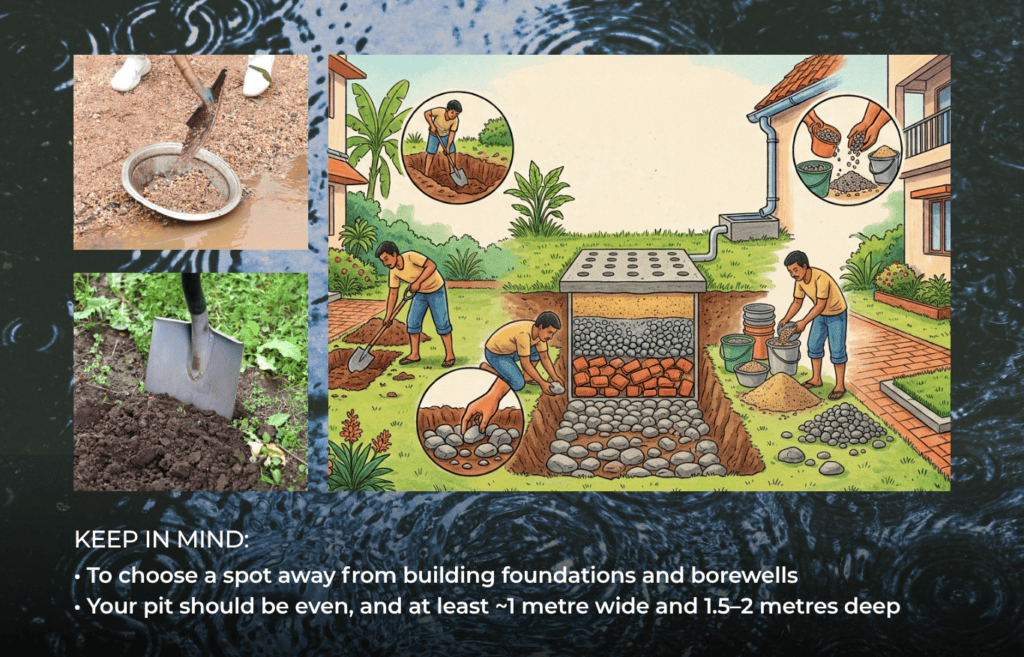
- Choose a spot a few metres away from building foundations and borewells
- Dig a pit (even ~1 metre wide and 1.5–2 metres deep is effective)
- Layer from bottom up: stones, then gravel, then coarse sand
- Channel runoff into the pit through a simple inlet drain, using mesh to block debris
- Cover the top with a slab or grate for safety, leaving a small inspection opening
- Key detail: Clean the top sand layer before each monsoon—surface clogging is the most common reason these systems stop working over time.
- Timing tip: The best window to build this is March–May, when the ground is dry and easy to dig. A pit started mid-monsoon fills with water before you can finish layering it properly.
- Impact:
Redirects rainwater into the ground instead of drains, helping recharge the local water table—especially valuable in urban areas where most surfaces are paved and impermeable.
3. A Monsoon-Hardy, Mosquito-Deterrent Garden (Two-for-One)
[Effort: Medium | Impact: High | Cost: Medium]
- The Why:
Monsoon is peak growing season—but it’s also peak mosquito season. With the right plants and proper drainage, your balcony can grow herbs and veggies without becoming the neighbourhood’s newest mosquito nursery. - The What (and their whys):
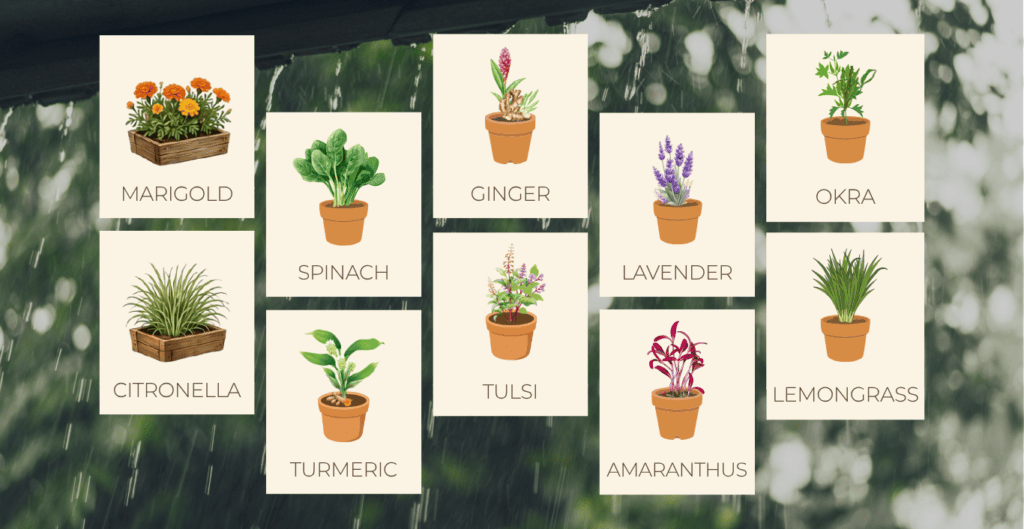
- Citronella and lemongrass — contain natural insect-repelling compounds; citronella is strongest, lemongrass is easier to maintain
- Tulsi and marigold — repel smaller pests and double as functional plants (culinary, medicinal, companion planting)
- Monsoon crops like turmeric, ginger, amaranth, and okra — thrive in humidity and grow faster during this season
- Malabar spinach and gourds — better suited for heavy rain than delicate greens like coriander or mint
- To build:
- Medium to large containers (10–25L depending on plant)
- Well-draining soil (garden soil + compost + cocopeat/sand)
- Basic elevation (bricks or stands)
- Simple support structures for climbers (bamboo or jute trellis)
- The How:
- Use containers with multiple drainage holes and elevate them to prevent waterlogging
- Mix soil for aeration (roughly 2:1:1 soil, compost, cocopeat/sand)
- Arrange plants by height—taller citronella or lemongrass at the back, smaller plants like tulsi or marigold in front
- Ensure 4–6 hours of sunlight and rotate pots if one side gets oversaturated
- Add a simple trellis for climbers like gourds
- Empty any water collected in trays or saucers every 1–2 days
- Key detail: Waterlogging, not lack of care, is what kills most monsoon gardens. Elevation and drainage matter more than frequent watering.
- Impact:
A well-set-up monsoon garden can be both productive and protective—yielding fast-growing crops while reducing mosquito presence and making small urban spaces more resilient during the rains.

4. Natural Dehumidifiers for Damp Corners (Who Needs Electricity?)
[Effort: Low | Impact: Medium | Cost: Very Low]
- The Why:
Monsoon humidity has a habit of sneaking into every corner of the house. A few simple household ingredients can help keep cupboards, bathrooms, and other damp spaces drier—no electricity required. - The What (pick based on the space):
- Rock salt — most effective for bathrooms or slightly larger areas; lasts 2–3 months
- Activated charcoal — absorbs both moisture and odour; ideal for wardrobes and can be reused
- Baking soda — best for very small spaces like shelves or shoe racks; needs frequent replacement
- The How:
- Rock salt — Place in a perforated container nested inside a second one to collect brine; empty periodically
- Charcoal — Fill a breathable pouch or ventilated container and place in enclosed spaces
- Baking soda — Keep in an open bowl or jar with holes; replace once it hardens
- Key detail: Place these in dead-air or high-moisture zones—inside cupboards, under sinks, near windows—rather than the centre of a room, since they work as point absorbers.
- Tip: Activated charcoal can be refreshed by leaving it in direct sunlight every couple of months, instead of replacing it.
- Impact:
Reduces dampness and odour in small spaces without relying on energy-intensive or plastic-heavy dehumidifiers—though it won’t replace proper ventilation or fix active leaks.
A Small System, Repeated
Taken individually, none of these projects feel revolutionary. A balcony drum. A mosquito-repelling pot. A rain chain. None of them will fix a city’s water crisis—and that was never really the point.
Together, they reflect a different way of approaching the season—less about coping, more about adapting. The monsoon isn’t a problem to be solved. It’s a cycle to be understood, and where possible, aligned with.
Sustainability rarely announces itself as a grand fix. More often, it shows up in small, repeatable choices: collecting water instead of wasting it, reusing instead of buying new, adjusting habits instead of resisting the season entirely.
Pick one project this monsoon. Do it properly. Then pick another next year.
Maybe that’s the real shift this season offers—not a bigger system, but a quieter, more intentional way of living within the one we already have.